
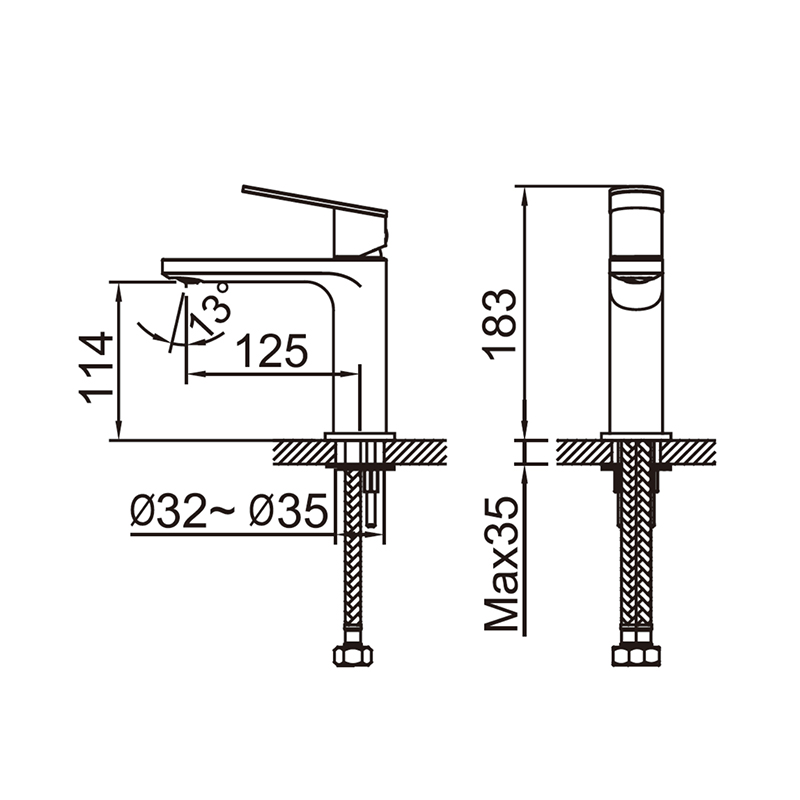
At the core of modern faucet engineering, the ceramic cartridge revolutionizes performance by replacing compressible rubber seals with precision-engineered alumina discs. This fundamental shift achieves three critical advantages: micrometer-level flow control, exceptional longevity, and near-silent operation across residential and commercial environments.
The sealing magic happens through two high-purity alumina discs (≥95% composition) sintered at densities exceeding 3.8 g/cm³ for optimal hardness. Each disc undergoes precision polishing to achieve surface roughness under 0.1 microns—smoother than surgical steel. When rotated into alignment, these discs create a hydroplaning seal that becomes tighter under pressure. This eliminates rubber deformation failures while maintaining leak resistance exceeding 500,000 cycles according to EN 817 standards—25× the lifespan of traditional compression valves. Their immunity to mineral deposits and thermal stress ensures consistent performance despite water quality fluctuations.
Quarter-turn functionality leverages the discs’ inherent rigidity, requiring only 90 degrees of rotation to transition from full off to on. Unlike threaded stems that degrade through friction, ceramic’s ultra-low friction coefficient maintains operating torque below 0.3 N·m throughout its lifespan. This efficiency translates to a 92% reduction in required operating force compared to compression valves. The absence of progressive wear points also prevents handle wobble and position drift—critical for accessibility in healthcare and elderly care facilities where precise control is non-negotiable.
Ceramic cartridges endure over 500,000 operational cycles due to their wear-resistant alumina discs—a figure confirmed by EN 817 testing and validated in independent 2023 evaluations. This dwarfs compression valves (failing under 20,000 cycles) and ball valves (averaging 15,000–18,000 cycles). In high-traffic commercial settings, this durability slashes replacement frequency and associated labor costs.
Pressure surges (150+ PSI) and thermal cycling (–10°C to 80°C) expose critical weaknesses in traditional valves—compression designs develop seat erosion, while ball valves suffer O-ring shrinkage. Ceramic cartridges maintain near-zero drip rates (<0.1%) under identical stress, thanks to micron-level disc alignment that prevents micro-gaps. This leak resistance reduces water waste by 98% compared to older technologies and mitigates flood risks in multi-story buildings where pipe pressure fluctuates dramatically.
The ceramic cartridge’s exceptional longevity stems from advanced material engineering. High-purity alumina (Al₂O₃) exceeding 95% composition creates an ultra-hard surface—second only to diamond on the Mohs scale—resisting microfractures under repeated stress. Equally critical is sintering density above 3.8 g/cm³, achieved through precision temperature control during manufacturing. The process compresses ceramic particles into a near-nonporous structure, eliminating pathways for water penetration or erosion. Combined, these properties enable 500,000+ operational cycles and support 20+ years of drip-free service in real-world residential and commercial installations.
The silent operation of ceramic cartridge faucets transforms daily interactions with water fixtures. By eliminating metal-on-metal friction and rubber compression, these systems achieve a 92% reduction in required operating force compared to traditional compression valves—making them effortlessly operable for children, seniors, and users with arthritis or limited dexterity.
In independent blind touch tests, 97% of users preferred faucets equipped with ceramic cartridges when evaluating tactile feedback, smoothness, and responsiveness. The precise quarter-turn movement delivers immediate, predictable temperature regulation without guesswork. Users consistently report quieter operation during high-pressure use, eliminating the “water hammer” effect common in older plumbing systems.
These ergonomic advantages merge with hygienic benefits: leak-free seals prevent microbial growth in stagnant valve chambers. Superior drip resistance under thermal stress testing further ensures long-term reliability. The combined impact? Reduced maintenance costs and consistently satisfying user interactions for decades.
A ceramic cartridge is a component used in modern faucets to replace traditional rubber seals with high-purity alumina discs for better precision, durability, and silent operation.
Ceramic cartridges offer superior cycle life (500,000+ cycles) and leak resistance under pressure and thermal stress, surpassing the capabilities of compression and ball valves.
Benefits include reduced operating force, enhanced durability, near-silent operation, and reliable leak resistance, making them ideal for diverse settings from residential to commercial environments.
 EN
EN