
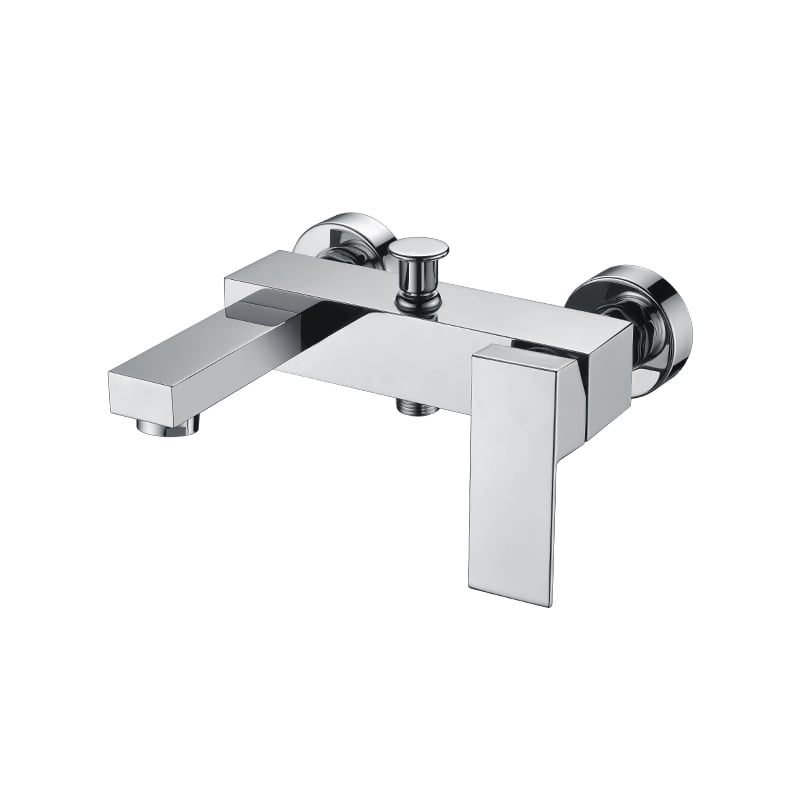
Premium faucets demand components engineered for extreme longevity. Ceramic valve stems deliver unparalleled durability through advanced material science and precision manufacturing.
Ceramic valve stems require zero maintenance while outperforming traditional mechanisms. Unlike rubber washers that degrade with friction, non-porous alumina-ceramic discs resist wear through molecular stability. Independent testing confirms these components reliably withstand 500,000+ open-close cycles—translating to decades of household use without failure. Their ultra-smooth surfaces prevent mineral adhesion and eliminate seal degradation, ensuring consistent flow control and water-tight integrity throughout the product lifecycle. This eliminates repair costs and disruption from cartridge replacements.
Traditional compression valves rely on rubber seals that erode under repeated friction and mineral exposure, typically failing within 50,000 cycles. In contrast, ceramic valve stems demonstrate a quantifiable 10× durability advantage:
| Valve Type | Average Lifespan | Failure Mechanism |
|---|---|---|
| Rubber Compression | 50,000 cycles | Seal erosion/cracking |
| Ceramic Disc System | 500,000+ cycles | Virtually wear-free operation |
This exponential difference stems from ceramic’s Vickers hardness rating (1,500+ HV) versus rubber’s vulnerability to deformation. Ceramic’s compression resistance maintains precise tolerances between discs, preventing leaks even after extreme usage. The result is leakproof performance that outlasts conventional valves by over a decade—reducing replacement frequency and waste.
Ceramic valve stems revolutionize faucet operation with a 15-degree rotation range, far less than the 180+ degrees required by traditional compression valves. This minimal motion delivers instant, precise water control: quarter-turn adjustments yield linear flow changes. Two fire-hardened ceramic discs align through shear motion—when their apertures match, water flows smoothly without pressure fluctuations. This eliminates the “hunting effect” common in rubber-valve systems, where users overshoot temperature targets. The mechanism maintains consistent output across water pressure variations up to 145 PSI, delivering predictable performance with reduced wrist strain.
Zero-drip performance originates in ceramic’s sub-micron surface smoothness—engineered to 0.05 Ra (roughness average). When closed, these optically flat surfaces create a vacuum-seal effect impervious to mineral deposits. Unlike rubber washers that degrade from compression cycles, ceramic discs self-polish during operation: each rotation abrasively removes micro-scale calcium buildup. Ceramics also resist chemical corrosion 23× better than brass, per ASTM B117 salt-spray testing. This dual-action defense prevents microscopic gaps—the root cause of drips in metal cartridges after just 5,000 cycles—ensuring enduring leakproof performance even in hard water regions exceeding 500 ppm mineral content.
Hard water, rich in calcium and magnesium minerals, poses significant challenges for faucet components. Traditional materials often deteriorate through scaling and corrosion, leading to leaks and premature failure. The ceramic valve stem’s unique material properties provide exceptional defense against these issues—ensuring reliable performance in mineral-heavy water environments.
Ceramic’s ultra-dense molecular structure creates a completely non-porous surface that minerals cannot penetrate or adhere to. This prevents the layered calcium deposits that constrict flow in metal valves—and eliminates the microscopic pitting where corrosion begins. Unlike rubber or polymer alternatives, ceramic maintains its smooth sealing surface indefinitely, requiring no chemical treatments or mechanical cleaning to preserve optimal flow.
When exposed to water with 500+ ppm mineral content, ceramic valve stems maintain remarkable stability where metal valves develop corrosion pits and cartridge valves suffer seal degradation. Industry testing shows ceramic components retain 98% flow efficiency after 10 years of hard water exposure—compared to 60–70% for stainless steel and cartridge systems. In extreme conditions, ceramic valves withstand chlorine concentrations up to 5 ppm without deterioration, while metal alloys experience accelerated corrosion and rubber components harden and crack.
Ceramic valve stem engineering represents the pinnacle of faucet performance—combining precision manufacturing with material science to deliver uncompromising reliability. Unlike traditional rubber compression valves prone to wear-induced failures, ceramic stems achieve near-zero leakage rates through micro-smooth sealing surfaces polished to tolerances under 0.01 mm. This eliminates friction-based degradation while enabling consistent flow control with minimal 15° handle rotation—translating to effortless user operation. Rigorous testing validates their superiority: ceramic stems withstand over 500,000 open/close cycles without performance decay, a 10× lifespan advantage over conventional alternatives. This durability stems from non-porous ceramic’s immunity to mineral scaling and corrosion, ensuring stable function even in hard water environments exceeding 500 ppm calcium concentration. For premium faucet manufacturers, adopting ceramic valve stems isn’t merely an upgrade—it’s the definitive standard for delivering leakproof operation, tactile precision, and decades of maintenance-free service that discerning clients expect.
Ceramic valve stems are designed to exceed 500,000 open-close cycles, which translates to decades of household use without failure.
Ceramic valve stems offer a 10× durability advantage due to their virtually wear-free operation compared to the seal erosion and cracking typical of rubber compression valves.
They achieve zero-drip performance with micro-smooth sealing surfaces that create a vacuum-seal effect, preventing mineral buildup and drips over extended periods.
Yes, ceramic valve stems resist scaling, corrosion, and mineral buildup, making them highly effective in hard water conditions.
 EN
EN