
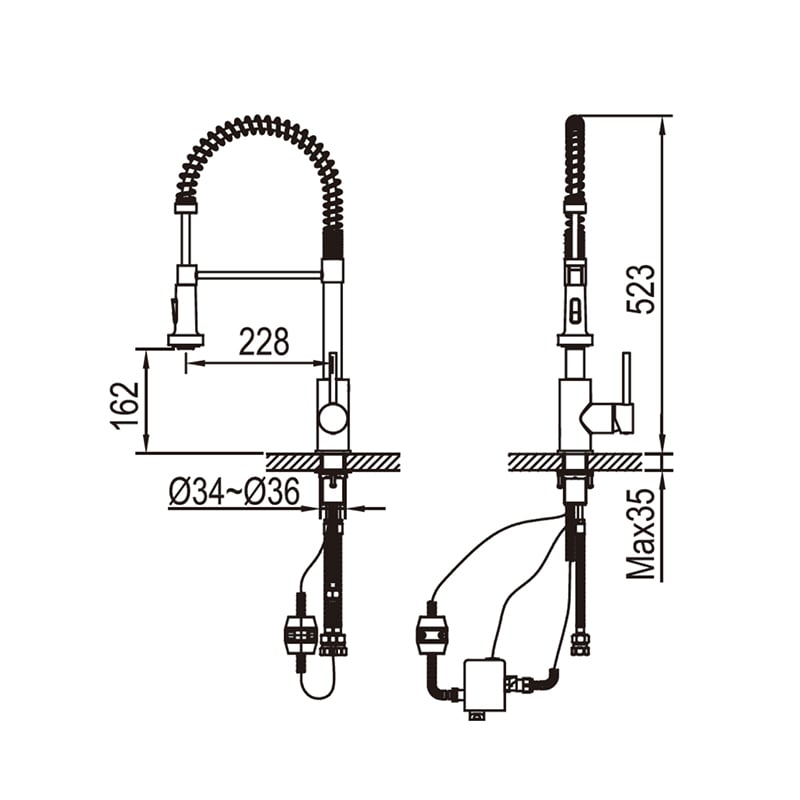
For B2B procurement teams, sourcing factory direct faucets eliminates costly intermediaries—distributors, importers, and retailers—delivering immediate per-unit cost savings. Manufacturers offer volume-based discounts and flexible payment terms (e.g., 30% deposit, balance before shipment), enabling meaningful reductions on large-scale commercial or residential projects. Beyond price, direct access unlocks broader product portfolios and true customization: from solid brass composition and ceramic cartridge specs to bespoke finishes and ADA-compliant ergonomics—ensuring precise alignment with project requirements, reducing field modifications, and elevating end-user satisfaction. Critically, a direct buyer–manufacturer relationship accelerates post-sale support: technical guidance on installation, maintenance, and troubleshooting is delivered promptly by engineers familiar with the product’s design—minimizing downtime and strengthening long-term lifecycle value.
Finding a trustworthy factory direct faucet partner requires understanding China’s distinct manufacturing geography. Production is concentrated in three primary hubs—Kaiping, Nan’an, and Wenzhou—each with clear quality tiers, material preferences, and market focus. Selecting the right region is the foundational step in aligning supplier capability with your brand’s performance standards and compliance needs.
To evaluate suppliers effectively, differentiate the core strengths of each cluster—not just location, but engineering capacity and regulatory readiness.
| Hub | Province | Core Focus | Typical Materials |
|---|---|---|---|
| Kaiping (Jiangmen) | Guangdong | High-end, premium exports | Solid brass, high-grade stainless steel |
| Nan'an | Fujian | Mid-range, domestic market | Brass, zinc alloy |
| Wenzhou | Zhejiang | Budget, mass-market | Zinc alloy, lower-cost brass |
Kaiping stands apart as the benchmark for international-grade factory direct faucets. Its factories routinely invest in thick-walled brass casting, multi-layer electroplating (e.g., Ni-Cu-Ni-Cr), and ISO 9001-certified quality systems—making them the preferred source for buyers targeting North American or EU markets with strict lead-free and durability mandates. In contrast, Nan’an and Wenzhou prioritize cost efficiency for domestic use; their reliance on zinc alloy introduces higher risk of cracking under thermal cycling or pressure surges—unsuitable for commercial installations requiring longevity or code compliance. For B2B buyers prioritizing reliability over lowest landed cost, Kaiping remains the most defensible starting point.
After selecting a region, clarify whether your brand requires full design control or speed-to-market advantage—this determines whether OEM or ODM best serves your strategy.
The decision isn’t binary: many mature buyers begin with ODM to test market fit, then transition key SKUs to OEM once volume and feedback justify dedicated tooling. A reputable Kaiping-based supplier will support both paths—and transparently disclose which models are ODM-ready versus those requiring OEM investment.
Certifications are not administrative formalities—they’re non-negotiable gateways to market access, legal compliance, and reputational safety. For B2B buyers, verifying these credentials is the single most effective risk-mitigation action during supplier evaluation. A credible factory direct faucet supplier doesn’t just claim certification; it provides verifiable numbers, test reports, and documentation traceable to accredited bodies.
Each major market enforces distinct, legally binding plumbing standards. A single faucet may require multiple certifications depending on its destination—failure to secure the correct ones triggers rejection at customs, costly recalls, or liability exposure.
| Certification | Primary Market | Core Purpose |
|---|---|---|
| CUPC | North America (USA/Canada) | Validates mechanical integrity, structural safety, and water efficiency per ASME A112.18.1 |
| NSF/ANSI 61 & 372 | North America | Confirms potable water safety and ≤0.25% weighted average lead content |
| WRAS | United Kingdom | Ensures no contamination risk and backflow prevention per BS EN 1717 |
| CE | European Union | Declares conformity with the Construction Products Regulation (CPR) and EN 817/EN 200 |
| WaterMark | Australia & New Zealand | Mandatory certification for legal installation under AS/NZS 3718 |
| WaterSense | USA | EPA-backed label certifying ≥20% water savings vs. baseline models |
| WELS | Australia | Requires mandatory 3-star minimum rating and on-product labeling per AS/NZS 6400 |
A robust supplier maintains active, current certificates—not expired or “in process” documents—and can provide test reports from labs like IAPMO, NSF International, or SGS. Crucially, they’ll specify which models carry which certifications, as not all SKUs in a catalog meet every standard.
Certification confirms baseline conformance—but real-world reliability depends on how rigorously a supplier stress-tests beyond minimums. Leading Kaiping factories conduct internal validation that exceeds third-party requirements:
These protocols simulate 10+ years of commercial use. Requesting dated test reports—and cross-referencing them with batch-specific production records—is standard practice in professional supplier audits. It separates manufacturers who engineer for longevity from those who merely pass compliance checklists.
A disciplined, repeatable procurement workflow is essential to securing consistent quality, predictable timelines, and enforceable accountability. The proven 7-step process balances diligence with efficiency:
This sequence transforms procurement from transactional purchasing into strategic supply chain development—building trust, predictability, and scalability.
Even seasoned procurement professionals encounter avoidable pitfalls when sourcing factory direct faucets. Proactive risk mitigation starts before the first payment—not after a shipment arrives non-compliant. The most effective countermeasures are contractual, evidence-based, and embedded early in the supplier relationship.
Sourcing factory direct faucets eliminates intermediaries, reduces costs, ensures access to a wide product portfolio, enables customization, and improves post-sale technical support.
OEM involves custom manufacturing based on your specifications, while ODM provides pre-designed models that can be branded quickly, reducing time-to-market.
Key certifications include CUPC, NSF, WRAS, CE, WaterMark, WaterSense, and WELS, depending on the market.
Mitigate risks through clear contractual terms, sample testing, verifying certifications, and establishing written after-sales support agreements.
 EN
EN